New Temporalities: Blurring the Environmental and the Political in a Planetary Age
This post is a book review of Dipesh Chakrabarty’s “The Climate of History in a Planetary Age” (2021), with my own opinions on how historians should practice history in a planetary age.
A New Conception of ‘Time’ in the Anthropocene
Despite its obvious Eurocentric and parochial shortcomings, the ‘Anthropocene’ is a representative attempt to address the issue of human-induced climate change through history. In his book, The Climate of History in a Planetary Age, Dipesh Chakrabarty proposes that we have entered a new era of writing history as the geological conception of time has converged with the political. According to his thesis, the Anthropocene – the geological definition of our current climactic epoch of humans as geological actors – has coincided with the human-defined periodization of time of ‘modernity’ as the present. As our ability to act as geological agents in the Anthropocene is inseparable from our building of modern political regimes and globalisation, it only makes sense that the geological time of the Anthropocene is also the ‘now time’ of politics and history.
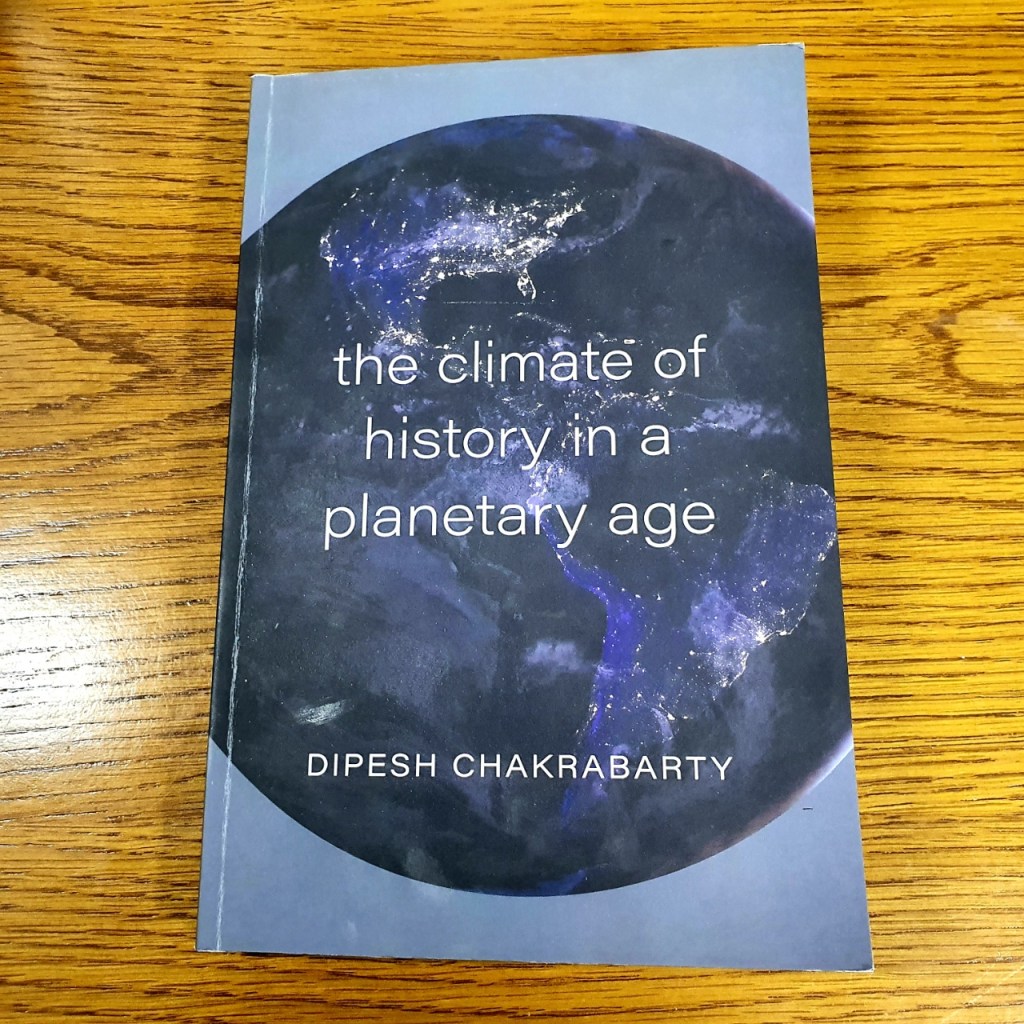
Such a concept of Anthropocenic ‘temporality’ also reveals the inadequacy of politics under the old definition of ‘time’ to resolve the problem of planetary climate change. The international institutions such as the United Nations made in the twentieth century to combat ‘global’ issues of politics that assume open and indefinite calendars have not at all been designed to deal with planetary climate change which has a finite and definite calendar. Hence, Chakrabarty argues that the convergence of the geological and political ‘present’ requires a reconciliation of the old political concepts that considered politics to be distinctly separate from the environment. Chakrabarty’s book thus promotes a need for thinking beyond the ‘global’ – a human-centric construct – towards a ‘planetary’ in the Anthropocene, a geological time in which historians must begin to think of new ways of writing history.
The Politics of the Environment as a Human Construct
There is nothing ‘natural’ about the environment. The environment is quite an artificial human construct, designed for discrete political purposes. One only has to read works such as William Cronon’s ‘The Trouble with Wilderness’ or Richard Grove’s Green Imperialism to discover that the myth of an untouched natural environmental space as dichotomous to human civilisation was created in the process of exerting European colonial dominion. These ‘untouched’ lands (for instance, the ‘wilderness’ beyond the Western U.S. frontier or the ‘tropical’ environment in Latin America) were, in fact, densely populated by local non-white peoples. However, claiming an ‘untouched wilderness’ was morally more justifiable and convenient than claims upon complex systems of local governance. Thus, the ‘environment’ was used with a distinctly political purpose to depoliticise the imperial subjugation of non-Western civilisations to European empires. The project of Western imperialism necessitated the conceptualisation of an ‘environmental’ space as strictly separate and dichotomous from the ‘social’– a dichotomy whose legacy continues to this day as politicians so easily shrug off the burden of environmental concerns for consumers and individual citizens, while remaining nonchalant about changing their attitudes towards ‘political’ matters of industrial production that lie at the core of our planet’s problems today.

Rethinking Our Old Conceptions of the ‘Political’
With this in mind, it is not enough for historians to simply do ‘environmental’ history in the wake of the climate crisis. Primarily, thinking of environmental history as a distinct sub-discipline will achieve the exact opposite of what environmental history should and is able to do. By framing the newly-emerging modes of environmental history and the Anthropocene into specialised fields (such as an ‘M.A. or Ph.D. Environmental History’ course), we unequivocally limit the power that environmental thinking promises for history. This is especially the case as the ‘environment’ is so omnipresent in our conceptualisation of every matter that constitutes any historian’s subject of interest. For instance, politics and economics are fundamentally related to questions of how to effectively make out of the land. Race, often expressed through racially-essentialist ideas such as ‘indigeneity,’ took part in the process of ascribing ownership to whoever belongs to that land. Gender was conceptualised from a discourse on who should and could most effectively make out of the land (often through crude definitions of ‘femininity’ and ‘masculinity’) and the power relations that stem from that discourse. Empire was a project of designing a system that could make out of the lands beyond European civilisation for colonial benefit. Hence, we are all inevitably environmentalists in that we are all inseparable from our relationships with the land and our surrounding environment.
Not surprisingly, outspoken ‘environmental’ works of history have often confined themselves to the conventional definition of the environment as a natural space ‘out there.’ Many works of ‘environmental history’ until the 1990s have limited themselves to merely recording histories about human destructions of the natural environment, without critically examining what the categorisation that framed their discipline as ‘environmental’ exactly was. Hence, a distinct sub-discipline of ‘environmental history’ is not something that historians must identify themselves with when thinking about the environment. Ultimately, according to Chakrabarty’s definition of the ‘planetary,’ historians must free themselves from the sub-disciplinary divide of the post-Enlightenment drive of university institutions to examine the environmental underpinnings that nature and science hold for the politics of human affairs.
The Point of History in a Planetary Age
The need to rethink our old conceptions of ‘political’ matters as being exclusively human and discretely separate from the ‘objective,’ ‘value neutral’ spheres of science and the environment is ever more prescient. International institutions designed based on an indefinite conception of time – or a human-centric ‘global’ in the place of a ‘planetary,’ as Chakrabarty puts it – that put excessive faith in humanistic values are not sufficient tools to equip ourselves in the struggle for a sustainable and intersectional climate justice. In this, historians can be at useful service. History has the power to denaturalise. Our discipline does not work with a fixed set of rules of what historians are meant to do; history has the power to question, deconstruct, and ultimately change the concepts that people so often tend to assume as given. Inevitably, all history is the history of the present. Amid a planetary emergency like ours, we as historians must continue to think outside of the Eurocentric, human-centric categories we have inhabited for so long to adapt our ways of political thinking to a ‘planetary’ age of climate change. Time is of the essence.
 The Green Ideology
