The Power of History: Aldo Leopold’s Environmentalism for COP 26

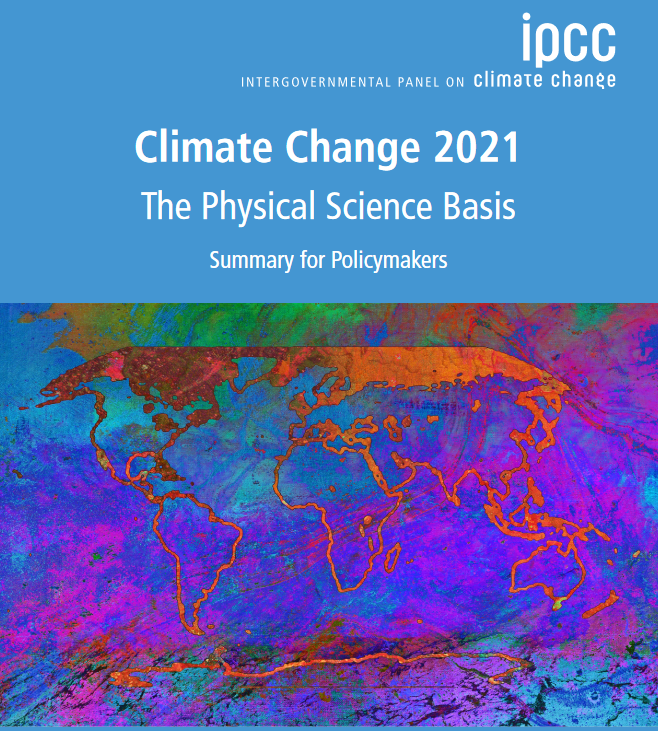
Time is running out. Temperatures have gotten hotter and sea levels higher. Scientists in the IPCC’s 6th Report have told us we have less than a decade to cross the 2°C point-of-no-return. Although we are keenly aware of ‘what’ we are supposed to battle, we seem to be completely lost on ‘how’ to bring about these changes that scientists remind us about. As we frown upon climate-change deniers while turning to science for objective solutions, we cannot help but ask: “Is there nothing we can do to help?” As non-specialists, are we meant to stand by and watch until the scientists come to save the day? In other words, what do history, politics, or ethics have to offer for the current climate crisis?

            The history of environmentalism may offer an insight. From the early-twentieth century, conservationist movements started arguing against the devastating effects of human technology on nature. Thanks to this first wave of activists, the familiar narrative of human destruction of the natural environment became increasingly popular.

However, not all environmentalists were satisfied with this narrative. Aldo Leopold, a U.S. ecologist, was one of them. In his Land Ethic, Leopold argued that people were not thinking ‘ethically’ enough about the land.

Aldo Leopold:1887-1948

For Leopold, ‘ethics’ is a cooperative mechanism that limits individual freedom for the sake of existence in a community. Simply put, if we slapped any random person we met, we would be exercising unlimited freedom. However, such disruptive acts are seen as intolerable to peaceful coexistence. To prevent this, we place a moral high ground on the act of ‘not slapping others.’ This enables any institutional penalties that may follow actions that cross this rule. Ethics is the mechanism behind this process that curtails our freedom to slap anyone to maintain our community.

Here, Leopold asks: “Do we ever restrict our freedom when taking from the land?” As humans, we are not only members of the social community but also the biotic community. However, there was no concept of ‘ethics’ when people imagined their relationship with nature, unlike that with humans. Particularly, Leopold was discontent with how people only thought of the land in economic terms: an exploitable resource, not a base of human life.

This ‘unethical’ way of thinking did not only result in environmental destruction. It also complicated the solution by shaping the language conservationists used to argue their case. As activists at the time argued only for the “economic” benefits of conservation, the non-profitable parts of nature (deserts, marshlands, etc.) were often disregarded, even though the “profitable” parts depended on these “non-profitable” parts for ecological regeneration.

Once we think of ourselves as members, not conquerors, of the ecological community, it only makes sense to limit our power to exploit the environment as its most powerful member. (Just as we wouldn’t punch someone weaker than us on the street for economic gains.) For Leopold, the land was where ethics ended and where economics started.
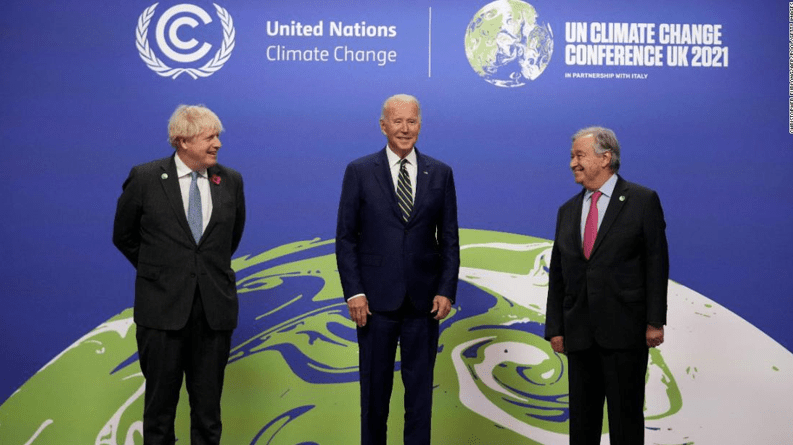
Glasgow COP26 2021 (CNN)

Then, is our perception of the current crisis any less problematic? Are we regarding the environment as we should? A look at the final pact of the Glasgow COP26 summit should tell us something about our current state.
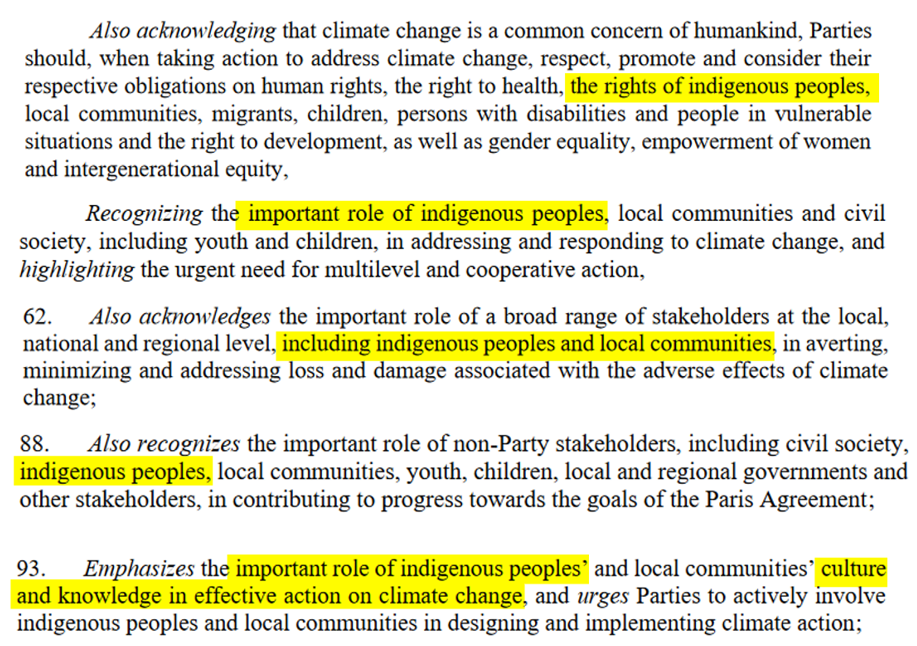
Articles mentioning ‘Indigenous peoples’

The COP26 summit addressed various issues, including the incorporation of indigenous people when consulting environmental issues. However, what is not mentioned is sometimes more important than what is. Nowhere do they mention who they mean by “indigenous peoples.” How they will consider the opinions of these people remains a mystery. Most absurdly, just outside of the gates of COP26 in Glasgow, a group of indigenous activists were protesting for representation. Ironically, COP26 was blocking out the exact people they promised to listen to.
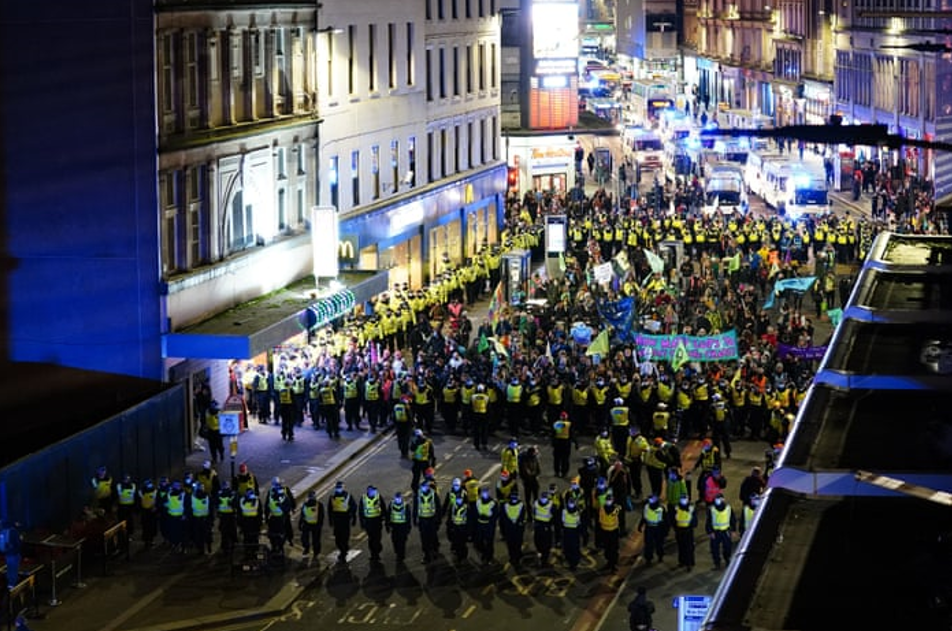
Protest in Glasgow during COP26 (Guardian)

The dictionary definition of indigenous is to “originate naturally from a particular land.” Under this definition, no race is indigenous to America: we all have migrated from Africa at some point in history. However, only people present in America before Columbus are considered “indigenous.” (We wouldn’t call a white person born in New York an “indigenous New Yorker.”) This implies how “indigenous” is a term coined from a European viewpoint that swipes numerous tribal nations under the carpet.

The biggest problem with this term is that, historically, “indigeneity” was used to oppress non-white people. In the nineteenth century, U.S. officials used the fact that these people maintained a lifestyle closer to nature to suggest that they were “backwards” and “primitive.” These racist assumptions were then used to appropriate their lands for U.S. benefit. Policies like the Indian Appropriations Act (1871) were justified on the basis that the “savages” of the tribal nations were not “civilised” enough to rationally use the land. The continuing tendency to view indigenous peoples as close to nature, yet not consider their voices with political weight implies a significant problem in resolving the climate crisis.
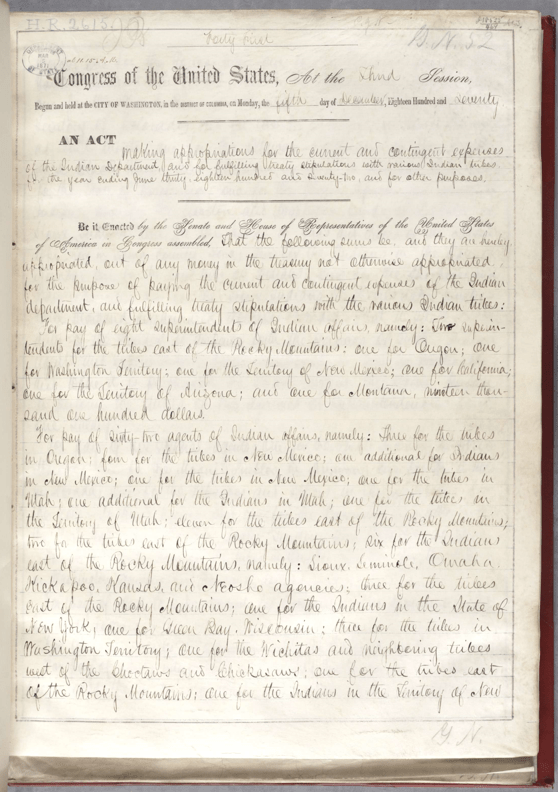
Indian Appropriations Act

We must think more politically when speaking of the environment. The history of environmentalism shows us that climate justice cannot be achieved by fighting within the conventional concepts made to separate nature from human life. As the conservationists of Leopold’s era were not thinking ethically enough about nature, the Glasgow Climate Pact shows us that we ourselves are not thinking politically enough about the human frameworks that underline the natural, scientific aspects of climate change. The failure of COP26 to represent grassroots protesters proves that we cannot rely on “experts” and heads-of-states to do this rethinking for us.

In this, history can be of useful service. History has the power to denaturalise. By looking at the history of how ideas like ‘ethics,’ ‘indigenous,’ or ‘environment’ were constructed, we can challenge traditional concepts that people often tend to assume as given. As the problem of climate change is always structural than individual, it is not enough to address environmental issues without tackling the political agendas that complicate its solution. We must continue to think beyond the categories we have grown accustomed to for so long. Time is of the essence.      

What is environmental history?

Is the ‘environment’ natural?

Before we begin, what even is the “environment”? We often think of the environment as synonymous with the natural world of animals, plants, and landscapes, where human civilisation hasn’t had its reach yet. A quick search on Google image reveals pictures of green, sublime images of the natural landscape. The dictionary definition of the environment is “the circumstances, objects, or conditions by which one is surrounded.” But such definitions seem a little absurd. Though we colloquially consider forests, mountains, rivers, and the biomes that inhabit it as part of the ‘natural environment,’ the border between what is natural and what is not becomes less clear-cut when we come closer to our own spheres of life. For instance, the pet dogs, domesticated cats, the eggs in the grocery store, roadside trees in the middle of the city… these are all, by right, part of ‘nature,’ yet we rarely think of them as part of the environment compared to their wild counterparts.

There is, however, one consistency in all these vague definitions of the environment:

  1. that our different depictions of the ‘environment’ are all devoid of humans, and
  2. that the closer natural organisms are to humans, they are considered ‘social’ rather that ‘environmental’ (for instance, leaves on a forest are considered to be part of the environment, whereas the parsley on my pasta for lunch today is not)
Google image search on ‘Environment’ – Where are all the humans?

Rather than having a stable definition in itself, we seem to think of the environment in terms of what it is not. In essence, we seem to think of the environment as anything not human.

            In today’s blog post, I wish to complicate this dichotomy a bit further. Studying the history of ideas (or ‘intellectual history’ as academics call it) tells us that there is a history to every abstract category. By looking at how categories such as gender, race, class, or ethnicity have been constructed by the ideas that people attribute to them, we can see how the categories we use colloquially today are not natural but artificial and human-made.

            But what about the ‘environment’? Some might consider it heretical to even question this categorisation. After all, the (natural) environment should be a pretty natural one, shouldn’t it? Even in the light of the current climate crisis and the wave of environmentalist movement following it, many would probably object to the act of trying to bring in any ‘human’ elements to the untouched, sublime environment. Still, since when did we start thinking of the environment as something separate from humans? Do we necessarily think about our surroundings the same way that people in medieval Europe did? Since when did we start distinguishing ourselves from our plant and animal counterparts to think of ourselves as part of a greater, super-human “society”? In other words, what is the history of the ‘environment’ as an idea?

Constructing the ‘Wilderness’ – The Case of North America

History reveals that there is nothing ‘natural’ about the environment. Our definition of the environment as something separate from human society is, as it turns out, an extremely Western one. Looking at the history of non-European lands, of non-White oppressed races and nations, we see that the environmental space was constructed with concretely political aims.

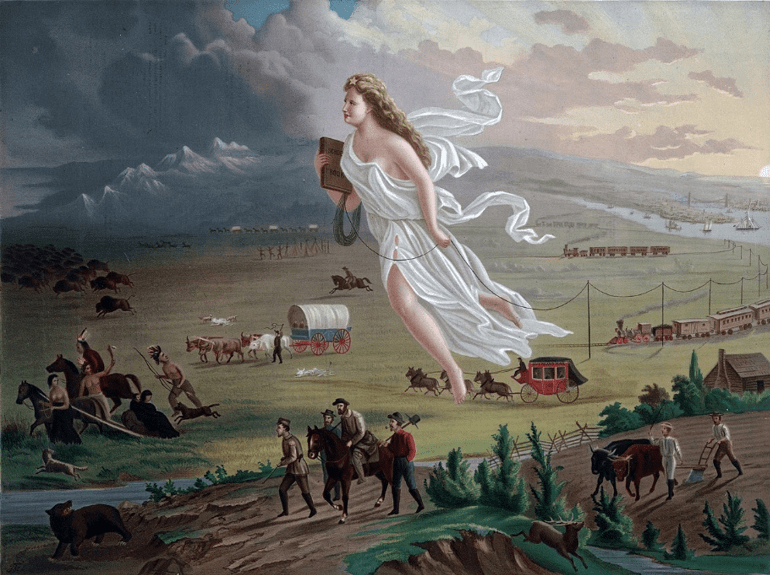
John Gast’s American Progress (1872) embodies the narrative of ‘Manifest Destiny’ as a destined expansion of U.S. civilisation upon the American wilderness.

The history of U.S. expansion in North America is a representative example of one such environmental space was constructed. From the 19th century onwards, the ‘wilderness’ beyond the U.S. Western border was seen as a sublime land untouched by human civilisation. As religious ideals of ‘God within nature’ grew stronger in transcendentalist movements of the 19th century, the North American wilderness became a glorified project for U.S. expansionist politicians. At the heart of this conceptualisation was the idea of an environmental space of the American ‘wilderness’ – a land thought to be untouched, untainted, and thus had yet to be developed by U.S. civilisation.

The problem of ‘wilderness’ is that the lands west of the U.S. were not untouched at all. In reality, the Western part of North America was densely populated by sophisticated societies of non-white tribes and rural farmers. Still, conquering an untouched ‘wilderness’ was easier than acquiring control over a land densely populated by diverse local peoples. As the wilderness was thought to be separate from human society, people in the U.S. did not oblige U.S. expansionist politics regarding the area as a matter of politics. Thus, depicting the western lands as an untouched wilderness enabled a depoliticization of a process that was, in fact, highly political and oppressive.

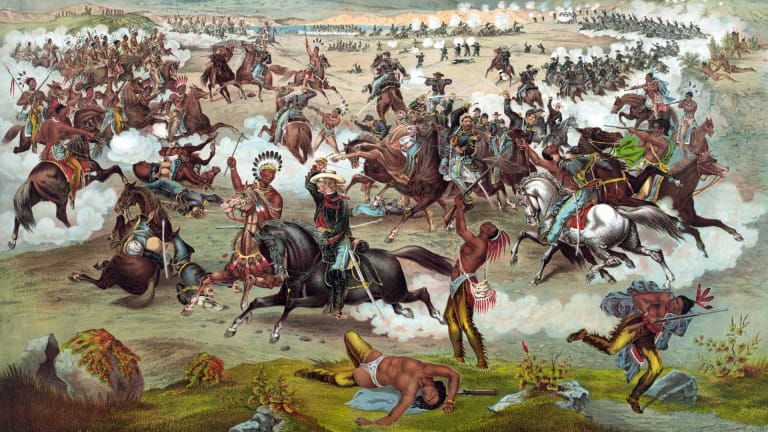
Brief footage of European “discoverers” conquering the American “environment.” (The Battle of Little Bighorn/credit: Buyenlarge/Getty Images)

Claiming an untouched ‘environment’ was easier than claiming a land densely populated by local non-white populations.

The history of ‘indigenous’ land appropriation shows how this ‘environment’ was not natural but in fact had very political repercussions (be mindful that the term ‘indigenous’ is an umbrella term that imposes a Western viewpoint that masks the variety of local tribal nations in the Americas). In 1871, the Indian Appropriations Act declared that ‘no Indian nation or tribe within the United States shall be acknowledged or recognized as an independent nation.’ The 1871 act mandated the forced relocation of these tribes to Indian reserves where they would be segregated and culturally ‘preserved’ from the influence of U.S. civilisation. In the solidification of U.S. nationhood, the existence of ‘savage’ tribal peoples in a ‘civilised’ nation like the U.S. was unacceptable. The frontier between the environmental ‘wilderness’ and society was actually one between diverse local non-whites and the U.S. empire.

Why we should think intersectionally when thinking about the environment

Therefore, environmental history is just about the ‘environment’ per se. The very definition of ‘environment’ (the surroundings in which an actor lives or operates) assumes that there is another subject that is central to its characterisation. Ignoring this component of environmental history by treating it as a discipline that only records facts about nature, biomes, and climates degrades the potential that history holds in an age such as ours. In essence, excluding humans from environmental history dehumanises and, consequently, depoliticises the discipline.

The current climate crisis is a distinctly human-made one and solving the crisis will require distinctly human approaches to the historical and political issues that complicate its solution. We cannot just wait for scientists to save the day. History has revealed that certain individuals or groups hold more responsibility than others in this crisis; ironically, those groups are also the ones that hold more power to bring about change for the better. Environmentalism and the struggle for environmental justice can only be sustainable when people of all races, ethnicities, genders, sexualities, classes, and nationalities have an equal voice in the solution. This is why we must think historically when thinking about the environment.

What Can History Do for the Current Climate Crisis?

New Temporalities: Blurring the Environmental and the Political in a Planetary Age

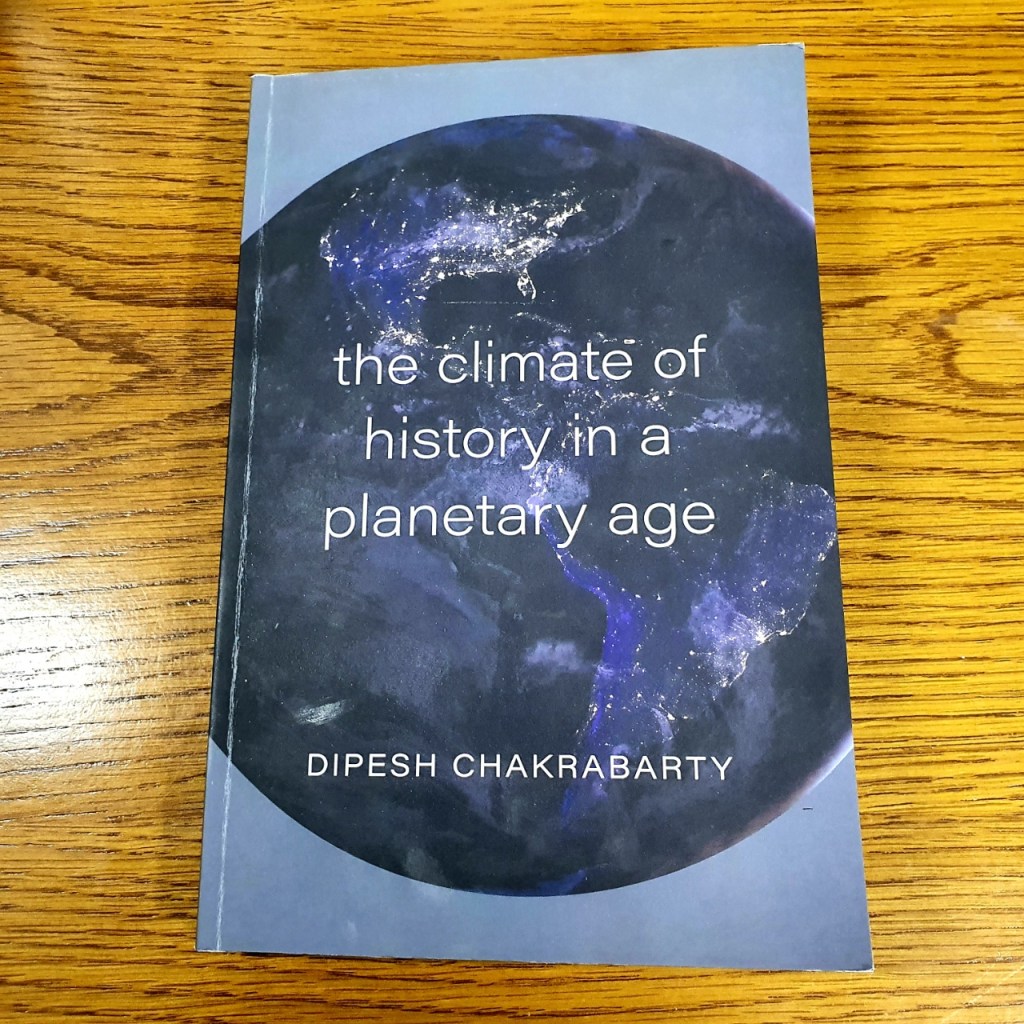
This post is a book review of Dipesh Chakrabarty’s “The Climate of History in a Planetary Age” (2021), with my own opinions on how historians should practice history in a planetary age.

A New Conception of ‘Time’ in the Anthropocene

             Despite its obvious Eurocentric and parochial shortcomings, the ‘Anthropocene’ is a representative attempt to address the issue of human-induced climate change through history. In his book, The Climate of History in a Planetary Age, Dipesh Chakrabarty proposes that we have entered a new era of writing history as the geological conception of time has converged with the political. According to his thesis, the Anthropocene – the geological definition of our current climactic epoch of humans as geological actors – has coincided with the human-defined periodization of time of ‘modernity’ as the present. As our ability to act as geological agents in the Anthropocene is inseparable from our building of modern political regimes and globalisation, it only makes sense that the geological time of the Anthropocene is also the ‘now time’ of politics and history.

Chakrabarty, Dipesh. The Climate of History in a Planetary Age, 2021.

Such a concept of Anthropocenic ‘temporality’ also reveals the inadequacy of politics under the old definition of ‘time’ to resolve the problem of planetary climate change. The international institutions such as the United Nations made in the twentieth century to combat ‘global’ issues of politics that assume open and indefinite calendars have not at all been designed to deal with planetary climate change which has a finite and definite calendar. Hence, Chakrabarty argues that the convergence of the geological and political ‘present’ requires a reconciliation of the old political concepts that considered politics to be distinctly separate from the environment. Chakrabarty’s book thus promotes a need for thinking beyond the ‘global’ – a human-centric construct – towards a ‘planetary’ in the Anthropocene, a geological time in which historians must begin to think of new ways of writing history.

The Politics of the Environment as a Human Construct

There is nothing ‘natural’ about the environment. The environment is quite an artificial human construct, designed for discrete political purposes. One only has to read works such as William Cronon’s ‘The Trouble with Wilderness’ or Richard Grove’s Green Imperialism to discover that the myth of an untouched natural environmental space as dichotomous to human civilisation was created in the process of exerting European colonial dominion. These ‘untouched’ lands (for instance, the ‘wilderness’ beyond the Western U.S. frontier or the ‘tropical’ environment in Latin America) were, in fact, densely populated by local non-white peoples. However, claiming an ‘untouched wilderness’ was morally more justifiable and convenient than claims upon complex systems of local governance. Thus, the ‘environment’ was used with a distinctly political purpose to depoliticise the imperial subjugation of non-Western civilisations to European empires. The project of Western imperialism necessitated the conceptualisation of an ‘environmental’ space as strictly separate and dichotomous from the ‘social’– a dichotomy whose legacy continues to this day as politicians so easily shrug off the burden of environmental concerns for consumers and individual citizens, while remaining nonchalant about changing their attitudes towards ‘political’ matters of industrial production that lie at the core of our planet’s problems today.

File:Cherokee Heritage Center - Trail of Tears Schild 2.jpg
Claiming an untouched ‘environment’ was easier than claiming a land densely populated by local non-white populations. / ‘The Trail of Tears’ (Wikimedia CC)

Rethinking Our Old Conceptions of the ‘Political’

With this in mind, it is not enough for historians to simply do ‘environmental’ history in the wake of the climate crisis. Primarily, thinking of environmental history as a distinct sub-discipline will achieve the exact opposite of what environmental history should and is able to do. By framing the newly-emerging modes of environmental history and the Anthropocene into specialised fields (such as an ‘M.A. or Ph.D. Environmental History’ course), we unequivocally limit the power that environmental thinking promises for history. This is especially the case as the ‘environment’ is so omnipresent in our conceptualisation of every matter that constitutes any historian’s subject of interest. For instance, politics and economics are fundamentally related to questions of how to effectively make out of the land. Race, often expressed through racially-essentialist ideas such as ‘indigeneity,’ took part in the process of ascribing ownership to whoever belongs to that land. Gender was conceptualised from a discourse on who should and could most effectively make out of the land (often through crude definitions of ‘femininity’ and ‘masculinity’) and the power relations that stem from that discourse. Empire was a project of designing a system that could make out of the lands beyond European civilisation for colonial benefit. Hence, we are all inevitably environmentalists in that we are all inseparable from our relationships with the land and our surrounding environment.

Not surprisingly, outspoken ‘environmental’ works of history have often confined themselves to the conventional definition of the environment as a natural space ‘out there.’ Many works of ‘environmental history’ until the 1990s have limited themselves to merely recording histories about human destructions of the natural environment, without critically examining what the categorisation that framed their discipline as ‘environmental’ exactly was. Hence, a distinct sub-discipline of ‘environmental history’ is not something that historians must identify themselves with when thinking about the environment. Ultimately, according to Chakrabarty’s definition of the ‘planetary,’ historians must free themselves from the sub-disciplinary divide of the post-Enlightenment drive of university institutions to examine the environmental underpinnings that nature and science hold for the politics of human affairs.

The Point of History in a Planetary Age

             The need to rethink our old conceptions of ‘political’ matters as being exclusively human and discretely separate from the ‘objective,’ ‘value neutral’ spheres of science and the environment is ever more prescient. International institutions designed based on an indefinite conception of time – or a human-centric ‘global’ in the place of a ‘planetary,’ as Chakrabarty puts it – that put excessive faith in humanistic values are not sufficient tools to equip ourselves in the struggle for a sustainable and intersectional climate justice. In this, historians can be at useful service. History has the power to denaturalise. Our discipline does not work with a fixed set of rules of what historians are meant to do; history has the power to question, deconstruct, and ultimately change the concepts that people so often tend to assume as given. Inevitably, all history is the history of the present. Amid a planetary emergency like ours, we as historians must continue to think outside of the Eurocentric, human-centric categories we have inhabited for so long to adapt our ways of political thinking to a ‘planetary’ age of climate change. Time is of the essence.

“Columbus Day” and the Dangers of Eurocentric Indigenous History

This eleventh of October marked the 29th anniversary of the Indigenous Peoples’ Day since the City Council of Berkeley renamed the day from its original form ‘Columbus Day’ in 1992. The day, established to restore agency to the people indigenous to the Americas marginalised in the colonialist rhetoric of ‘Columbus Day,’ received particular interest this year as U.S. president Joe Biden formally signed a presidential proclamation Indigenous Peoples’ Day to become a national holiday, becoming the first-ever president to recognise Indigenous Peoples’ Day. Though the need for the incorporation of indigenous peoples into the historical narrative should be a pretty straightforward one even without approval from a white president, the long-overdue recognition does imply a pressing need to contemplate the perceptions we have unquestioningly held about the past and their Eurocentricity. In the light of such events in October, in this month’s article, I will introduce a brief history of how discourses around the environment and environmentalism have put a white ‘Europe’ at its centre, marginalising the voices of BIPOC (Black, Indigenous, and People of Colour) communities.

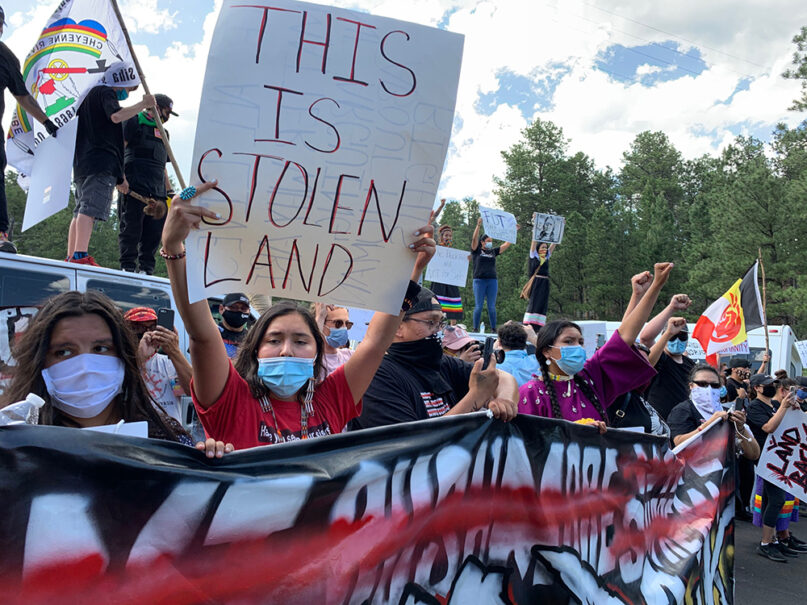
Native American protesters and supporters gather at the Black Hills, now the site of Mount Rushmore, on July 3, 2020 in Keystone, South Dakota. A multi-generational gathering, led by many young women and including different tribes, peacefully held the line.  (Photo by Micah Garen/Getty Images)
“This is Stolen Land” – Protesters and supporters gather at the Black Hills, now the site of Mount Rushmore, on July 3, 2020, in Keystone, South Dakota. (Photo by Micah Garen/Getty Images)

How non-white communities were more vulnerable to the effects of western environmental degradation

Environmentalism has existed before we found the language to express it from a European viewpoint. Though we often associate the incorporation of environmental factors in building our social spheres of life as a modern concept, the history of non-European environmental thought predates the invention of European ‘science’ modern environmentalism. Moreover, the dichotomous way of categorising nature as an external ‘environment’ as opposed to a ‘social’ sphere of human life is a European way of conceiving the structures around us. As those privileged enough to have their stories heard were often white activists, the ideas and accounts for environmental justice of BIPOC communities were often ignored and silenced.

This Eurocentric way of thinking about the environment is problematic as it precisely leaves out the very people who are most severely impacted by climate change and environmental degradation from the environmental discourse. As history unfolded into the 19th century and European empires went through mass industrialisation, the benefits of capitalist developments were exclusively reserved for WASP (White Anglo-Saxon Protestant) men, whereas non-white communities often had to deal with the consequences of industrialisation through the destruction of the environment. For instance, in the United States, cities were ‘colour-coded’ in order to regulate the kinds of housing you could purchase based on the colour of your skin. Even as the U.S. federal government created the Federal Housing Administration to provide loans so that the average person could own a home, ‘green’ coded homes that were of the highest value were all-white neighbourhoods, whereas districts that were coded ‘red’ were preserved exclusively for either integrated or all-black communities in the working-class. These red coded homes would be located where unregulated industrial production and waste emission affected life standards most severely (Melin Oliver, 2020).

Environmental degradation frequently threatened the lives of non-white workers in the agricultural sector as well. as Mexican workers deployed in the U.S. under the Bracero program were sprayed with DDT (Dichlorodiphenyltrichloroethane, a chemical compound used as insecticide famously introduced in Rachel Carson’s Silent Spring for its hazardous effects on the environment and human health) before they were sent to their contractors. Even today, dump fields and industrial sewages are located in places populated predominantly by Black and Brown communities who were chosen, in the words of a North Carolinian environmental protester Almena Myles, ‘because we were rural and poor and they thought we couldn’t fight’ (Bergman, BBC, 2019). Ironically, Black, Hispanic, Indigenous, and Asian migrant communities were being exploited to accelerate environmental destruction, from which they themselves would suffer the consequences. The glorious narrative of ‘progress’ and ‘rationality’ we often associate with capitalist development often erase and silence the histories of these people, upon whose labour and sacrifice of living conditions Western industrial development fundamentally relied.

Why we should think intersectionally when thinking about the environment

              The importance of thinking about intersectional histories of the environment and climate change comes from the fact that the obstacle to solving the climate crisis is a man-made one rather than a scientific one, in which certain individuals hold more responsibility than others. Merely directing the majority of the solutions to climate change to individualistic consumerism-based lifestyle reforms cannot address the bigger structural forces responsible for creating the climate crisis, while alienating people who are not affluent or privileged enough to maintain a consumerist “sustainable” lifestyle. Apocalyptic prognoses not based on sufficient scientific evidence that ‘we’re all doomed to die no matter what we do’ are bigoted and unhelpful, as such statements disregard the fact that climate change will first impact the peoples and societies least responsible for it. Environmentalism and the struggle for environmental justice can only be sustainable when people of all races, ethnicities, genders, sexualities, classes, and nationalities have an equal voice in the solution. Such inclusivity can only be achieved by considering the environmental history and the intersectional history of environmental thought, and this is where we as historians, not scientists, can contribute to the struggle for environmental justice.

Introduction: Why I’m a ‘Green Ideologist’

Hey, thanks for clicking.

I am a student of history who wishes to do this type of thing for a living – thinking, writing, educating and, hopefully, changing. I have named my blog the Green ‘Ideologist’ because I believe ideas are central to our world is conditioned and conceived. As a historian my job is to challenge what most people in our age would deem ‘natural’ by deconstructing the narratives we build around it. Ultimately, I tend to show how that which is the most natural to us is that which is constructed. What I mean by this will be clearer in the posts that will follow.

Silhouette, 2021

What the ‘Green’ means in the name of my blog is harder to explain with words. Frankly, I am fine with you associating anything that the word ‘green’ invokes in your mind, except for the one-dimensional portrayal of nature as simply something green and sublime. The point is that I want you to think about what we imagine as we picture the word ‘green’ and why that might be the case. For some reference, taking a look at the short scraps of writings and images on my homepage might help.