Can History Ever Become “Total”?

The ‘total,’ it seems, is more of a myth to the historian nowadays. Although many historians have attempted to brand their work to capture the ‘total’ in the names of world history, global history, macro history, l’histoire total, the dream to capture the entirety of the human past seems a little far-fetched to be more than a flashy catchphrase. Quantitatively speaking, historians may never capture the total, as history is never about the entirety of past-times but about selectively categorising the past into present inquiries. Hence, the ‘total’ has existed in the minds of historians than anywhere in the real world among many schools of historical thought. As the idea of ‘total history’ has changed over time to indicate different types of histories, total history is not defined by a particular spatial or temporal range or a specific scale of analysis; rather, it exists as a heuristic value according to what historians regard as the ‘total’ compared to their conventional frameworks of historical analysis.

What is Total History?
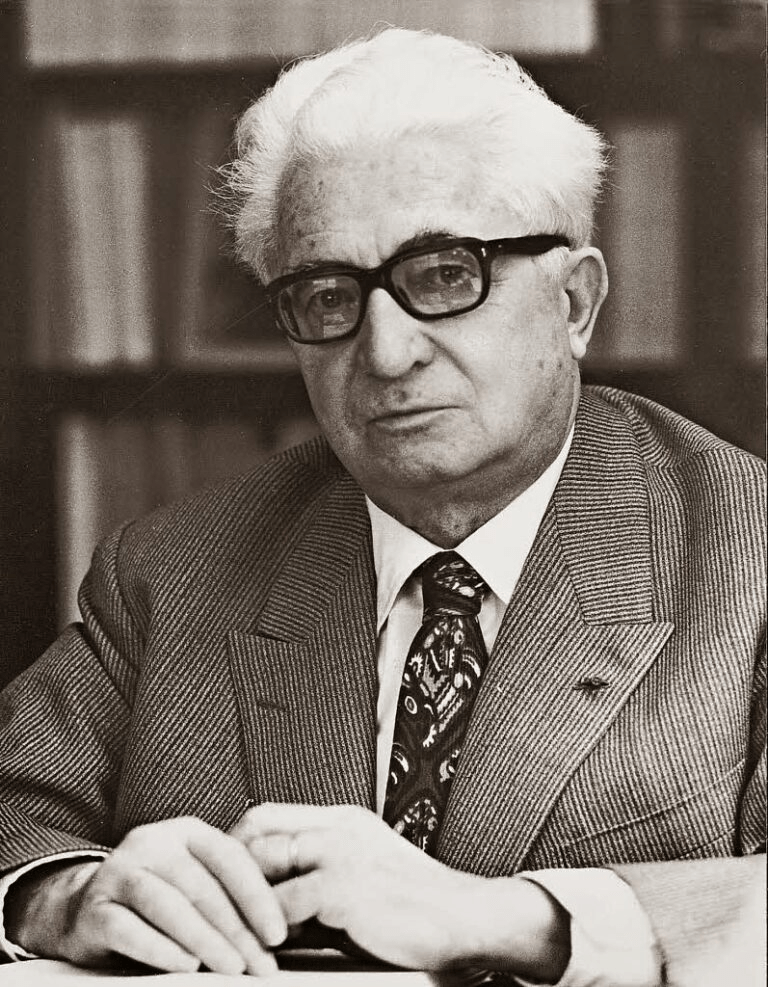
Fernand Braudel (Instituto Fernand Braudel de Economia Mundial)

Total history’ has changed to encompass different meanings over time. Historians, as early as in the twelfth century (Bernard Itier, Chronicle), have generally assumed their works to account for the totality of their subject matter. However, ‘total history’ as an outspoken historical subdiscipline began with the Annales school of French historians in the early twentieth century. Early Annales historians like Fernand Braudel distinguished their practise of the ‘total external’ – the deep, slowly-changing geographic and economic structures – from the ‘event-based’ histories of the short-term political (Mediterranean, 1949). Other historians like March Bloch or later historians of the Italian microstoria school put forth the idea of ‘the total internal,’ arguing that the total only existed inside people’s minds and social relations. Recently, environmental historians have advocated for a total history of humankind as a geological agent, as the concept of the Anthropocene encouraged historians to consider nature as a historical protagonist. As such, the idea of ‘total history’ has constantly changed according to what historians have regarded as the ‘total’ as opposed to conventional frames of analysis used by their contemporaries. Hence, total history is a subdiscipline that aims to expand the frameworks in which historians conduct their analysis, rather than a term that denotes a particular type, scale, or spatial range of historical writing.

The term ‘total’ is often misunderstood. J.H. Elliott, in his review of Braudel’s Mediterranean, criticised that total history is ‘not dissimilar to total war’ as ‘in both instances, you throw in everything you’ve got,’ implying that the ‘total’ did not mean anything more than a mere aggregate of different types of histories without any distinctive features of its own (1973). Moreover, certain microhistorians, especially those who embraced the postmodern ‘incredulity toward master-narratives of all types’ (Jean- François Lyotard, The Postmodern Condition, 1979), have critiqued the very notion of a ‘total’ history. Sigurdur Magnússon commented that by focusing on the uniqueness of the individual, microhistory denied the possibility of any overarching narratives (‘The Singularity of History’, 2003), while Giovanni Levi critiqued that the purpose of microhistory is to reduce the scale of analysis to undermine large-scale paradigms (‘Frail Frontiers?’, 2019).

However, these criticisms towards total history assume the ‘total’ is interchangeable with the ‘macro’ or the ‘global.’ Though colloquial uses of the word ‘total’ may have similar meanings to the macro (macroscopic analysis conducted on large groups of individuals) or the global (an extensive spatial range across geographic ranges), total history is not necessarily associated with large scales nor wide spatial ranges.

In terms of scale, the ‘total’ does not necessitate historians to focus on the macro. In The Cheese and the Worms (1976), Carlo Ginzburg wrote about the peasant culture during the Inquisition in sixteenth-century Italy from a microscopic scale of a single individual, a miller named Menocchio. From the fragments left by one idiosyncratic individual, Ginzburg constructed the totality of an unwritten peasant culture obscured from the view of previous historians.

Moreover, total history has also been written in small spatial spheres. Take, for example, Emmanuel Le Roy Ladurie, who wrote the total history of a single village by examining the ecological, cultural, religious, and sexual relations of its occupants (Montaillou, village occitan, 1978). Though certain total histories do cover wide spatial or temporal ranges, total history itself is not related to a particular scale nor any temporal or spatial range. These criticisms misunderstand total history as a field that quintessentially aims to establish definitive meta-narratives across wide spatial frames or macroscopic scales: neither of which concerns the aim of total history.

The Total External

History does not aim to establish a definitive ‘totality’ of the past; rather, historians seek to expand the frameworks of historical analysis to one in which their contemporaries are not accustomed to operating. To understand what frameworks historians try to expand requires considering the historiographical context in which different types of ‘total histories’ were written. To historians of the ‘total external’ such as Braudel, the ‘total’ meant considering structural factors external to human relations – the geographical and economic structures that shaped human interactions in the Longue Durée.
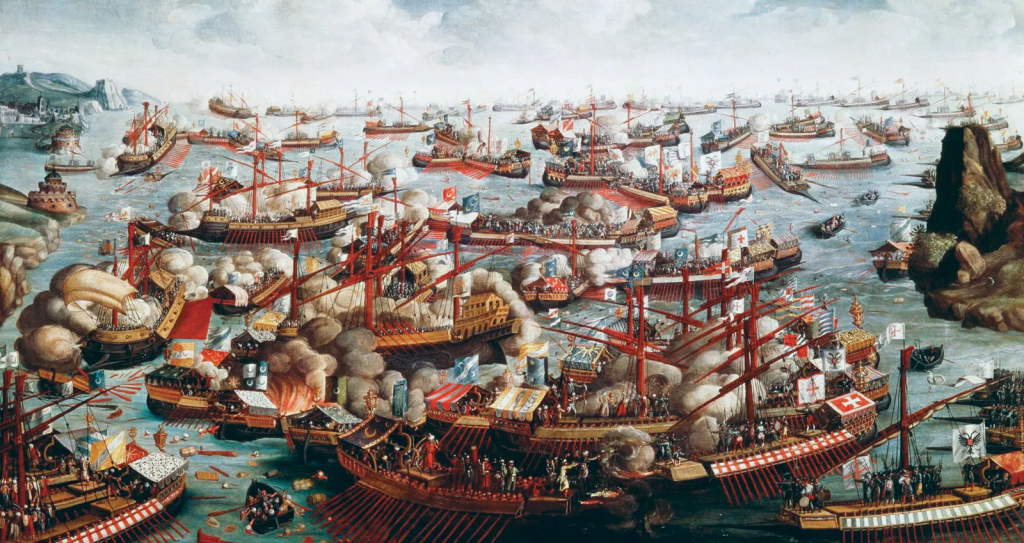
The Battle of Lepanto, October 7, 1571, in which the fleets of Spain, Venice, and the Papal States defeated the Turks in the last great sea battle involving galleys; in the National Maritime Museum, London.

For instance, in writing about the Battle of Lepanto in The Mediterranean, Braudel challenged the human-centricity of the Histoire événementielle (narrative-based history focused on historical events) practised before him. As he downplayed the importance of the event itself as ‘surface disturbances’ and ‘crests of foam’, Braudel emphasised the deep, underlying structures that preconditioned the battle before its occurence (1949). Moreover, in Out of Italy, Braudel opposed the historian Jacob Burckhardt in interpreting the Italian Renaissance (1974). While Burckhardt periodised the Renaissance as a two-hundred-year conjuncture characterised by unique individuals, Braudel sought to identify a deeper explanation of the Italian Renaissance as a continuity of long-term historical change. As such, the Braudelian ‘total history of the external’ sought to bring the historian’s attention to the deep, structural factors beyond the fleeting, ‘short-sighted’ human relations in political and diplomatic history.

The Total Internal

This ‘expansion of frameworks’ stands the same for another school of total history: the ‘total internal.’ Historians of the French Mentalités school focused on the collective ideas that escaped individuals to form the total. Jacques Le Goff characterised this mode of total history as studying ‘that which is common to Caesar and his most junior legionary… Christopher Columbus and any one of his sailors’, thus constructing the ‘total internal’ from the collective ideas between human relations (Mentalités, 1983).
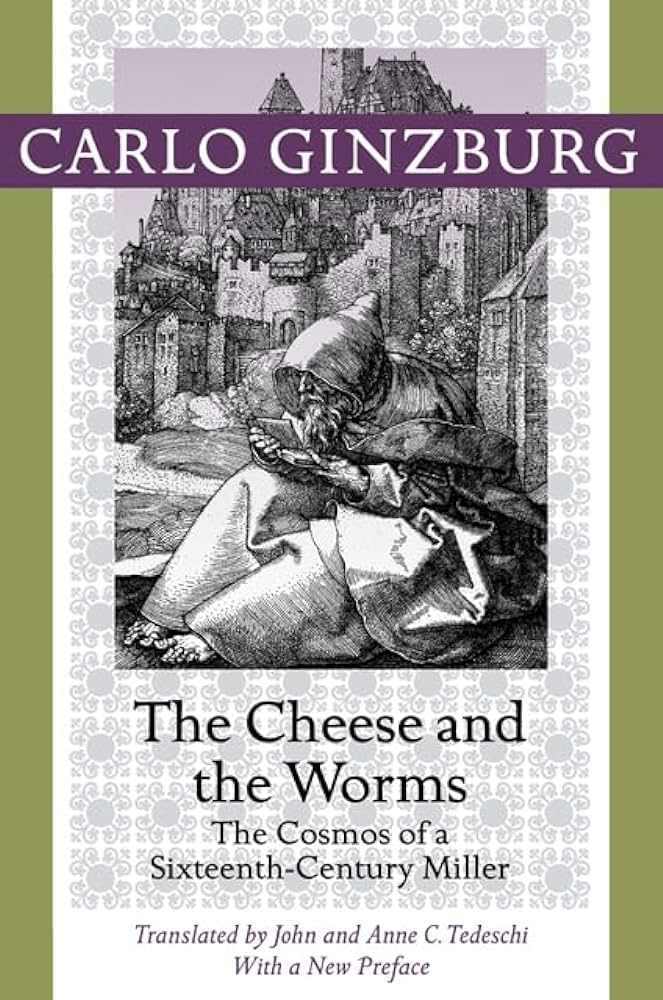
Carlo Ginzburg, The Cheese and the Worms (1976).

This mode of total history gained prevalence, especially after the ‘Cultural Turn’ of the 1970s. In this period, historians began focusing on the microscopic scale of individuals and small grassroots groups in their research. Whereas cultural historians before this period, such as Burckhardt or Johan Huizinga, tended to focus on high cultures of the elite while assuming high culture ‘trickled down’ to people at the grassroots level of society, microhistorians like Carlo Ginzburg established how historians could construct the entirety of the social relations within a whole peasant culture by looking at the records left by a single individual (1976). To these historians, the total could only be observed by reducing the scale of analysis to single individuals who served as ‘keyholes through which to view the world in which individuals lived’ (Tonio Andrade, 2010). Thus, the ‘total internal’ expanded the boundaries in which historians operated by incorporating these people marginalised from the top-down narratives of history before the Cultural Turn.

Total History Today

Likewise, environmental historians today – though the word ‘total history’ itself has generally fallen out of usage – have reinvented the old ambition to write a total history of humankind for the twenty-first century. Although historians practising Braudel’s structural analysis of the geological and the economic and Ginzburg’s small-scale archival research – both of which have generally become the norm of historical research today – claimed to be writing ‘total’ histories of their own, historians have only recently recognised the role of nature as an active agent in historical change.

However, as the concept of the Anthropocene (the current geological age in which human activity has been the predominant influence on the environment) quickly arose along with the ongoing climate crisis (Nicola Davison, The Anthropocene epoch, 2019), historians have questioned whether the conventional boundaries in which they operated were too human-centred. In 1996, William Cronon revealed that historians tended to dichotomise the relation between human society and nature in a naïve way that underwrote human society as where the ‘significant’ acts occurred and portrayed the environment as a passive ‘untouched nature,’ underestimating the degree to which human activity affects the natural environment (‘The Trouble with Wilderness’). Thus, the rise of nature as a driver of historical change challenged the portrayal of nature as a passive, theatrical background on the historian’s canvas upon which humans were the sole actors.

Accordingly, ‘total’ historians of the environment have challenged our place as central ‘human’ agents of historical change. Works that focus on the history of germs, animals, or pathogens and their relations to humans have redefined the place of human agents in the historian’s canvas and have expanded the boundaries of historical analysis to non-human agents. In Can the mosquito speak?, Timothy Mitchell (2019) analysed how disease and malaria shaped warfare and economic change, undermining the idea that humans were in command of the environment as fully active agents. As Bruce Campbell emphasised in ‘Nature as historical protagonist’ (2010), it has only been since the enlightenment era that humans saw themselves as omnipotent agents against a passive, benign natural environment. Like Campbell, many ‘total historians’ today aim to expand the twenty-first-century historian’s scope of research to non-human actors and the environment by recognising the role of nature as a historical protagonist.

Both Anna Lownhaupt Tsing’s The Mushroom at the End of the World (Left) and J.R. McNeill’s Mosquito Empires (Right) are excellent examples of how history can be expanded to include the non-human.

All of this is not to say history establishes a definitive ‘totality’ of the past. Every historian inadvertently prioritises some aspects of the past in choosing what better represents the ‘total.’ Historians of the ‘total external’ prioritise unchanging geographic and economic structures than short-term events, while historians of the ‘total internal’ disregard some parts of the past that are beyond the individual’s cognition in pursuit of a total history of the mental world. Nevertheless, the objective of total history has always been to achieve a comparative total by expanding the frameworks upon which historians operate. This is demonstrated by an active interest in interdisciplinary approaches shared by total historians of the ‘external’ and the ‘internal’ alike (Marc Bloch; Lucien Febvre, 1929). As total historians incorporate methods used in geography, economics, anthropology, or the natural sciences to the historian’s toolbox, they challenge the conventional frameworks in which historians view the past. Thus, the aim of total history is to expand the boundaries in which historians operate, not to claim their works to be definitive ‘totalities’ of the past.

Emmanuel Le Roy Ladurie (1929-2023).

In 1973, Le Roy Ladurie stated, ‘by the year 2000, historians will either be computer programmers or will no longer exist.’ In his remark, Le Roy Ladurie assumed historians had already expanded on all possible frameworks and that the only thing left of historical research would be the job of digital computers and quantitative analysis, which operate within the frameworks established at the time (‘L’historien et l’ordinateur’) Living in the twenty-first century, we know this has certainly not been the case. As conventional ideas of the ‘total’ are challenged, historians have been confronted by the elements to which they had been turning a blind eye: first to the ‘total external’ that revealed factors beyond the sphere of human relations and politics; then the ‘total internal’ which revealed the grassroots totality that had been marginalised by the top-down narratives before the Cultural Turn; lastly, the environmental total that redefined our position as human agents in relation to the environment and non-human agents around us. Thus, the historian’s work is only ‘total’ as they seek to expand the frameworks in which historical research is conducted.

The Power of History: Aldo Leopold’s Environmentalism for COP 26

Time is running out. Temperatures have gotten hotter and sea levels higher. Scientists in the IPCC’s 6th Report have told us we have less than a decade to cross the 2°C point-of-no-return. Although we are keenly aware of ‘what’ we are supposed to battle, we seem to be completely lost on ‘how’ to bring about these changes that scientists remind us about. As we frown upon climate-change deniers while turning to science for objective solutions, we cannot help but ask: “Is there nothing we can do to help?” As non-specialists, are we meant to stand by and watch until the scientists come to save the day? In other words, what do history, politics, or ethics have to offer for the current climate crisis?

            The history of environmentalism may offer an insight. From the early-twentieth century, conservationist movements started arguing against the devastating effects of human technology on nature. Thanks to this first wave of activists, the familiar narrative of human destruction of the natural environment became increasingly popular.

However, not all environmentalists were satisfied with this narrative. Aldo Leopold, a U.S. ecologist, was one of them. In his Land Ethic, Leopold argued that people were not thinking ‘ethically’ enough about the land.

Aldo Leopold:1887-1948

For Leopold, ‘ethics’ is a cooperative mechanism that limits individual freedom for the sake of existence in a community. Simply put, if we slapped any random person we met, we would be exercising unlimited freedom. However, such disruptive acts are seen as intolerable to peaceful coexistence. To prevent this, we place a moral high ground on the act of ‘not slapping others.’ This enables any institutional penalties that may follow actions that cross this rule. Ethics is the mechanism behind this process that curtails our freedom to slap anyone to maintain our community.

Here, Leopold asks: “Do we ever restrict our freedom when taking from the land?” As humans, we are not only members of the social community but also the biotic community. However, there was no concept of ‘ethics’ when people imagined their relationship with nature, unlike that with humans. Particularly, Leopold was discontent with how people only thought of the land in economic terms: an exploitable resource, not a base of human life.

This ‘unethical’ way of thinking did not only result in environmental destruction. It also complicated the solution by shaping the language conservationists used to argue their case. As activists at the time argued only for the “economic” benefits of conservation, the non-profitable parts of nature (deserts, marshlands, etc.) were often disregarded, even though the “profitable” parts depended on these “non-profitable” parts for ecological regeneration.

Once we think of ourselves as members, not conquerors, of the ecological community, it only makes sense to limit our power to exploit the environment as its most powerful member. (Just as we wouldn’t punch someone weaker than us on the street for economic gains.) For Leopold, the land was where ethics ended and where economics started.

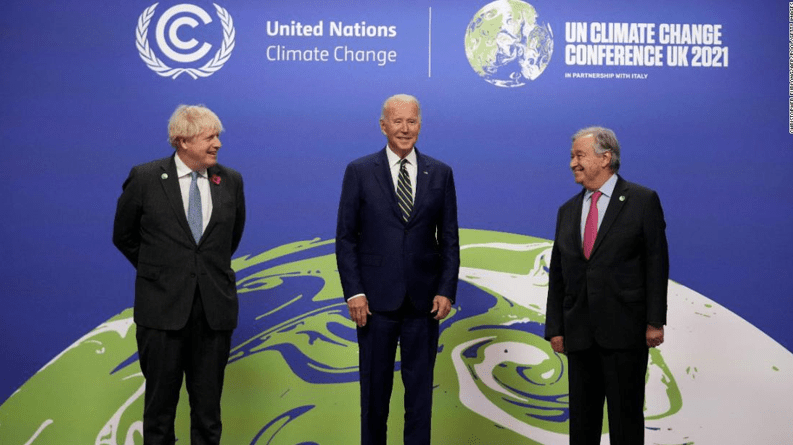
Glasgow COP26 2021 (CNN)

Then, is our perception of the current crisis any less problematic? Are we regarding the environment as we should? A look at the final pact of the Glasgow COP26 summit should tell us something about our current state.

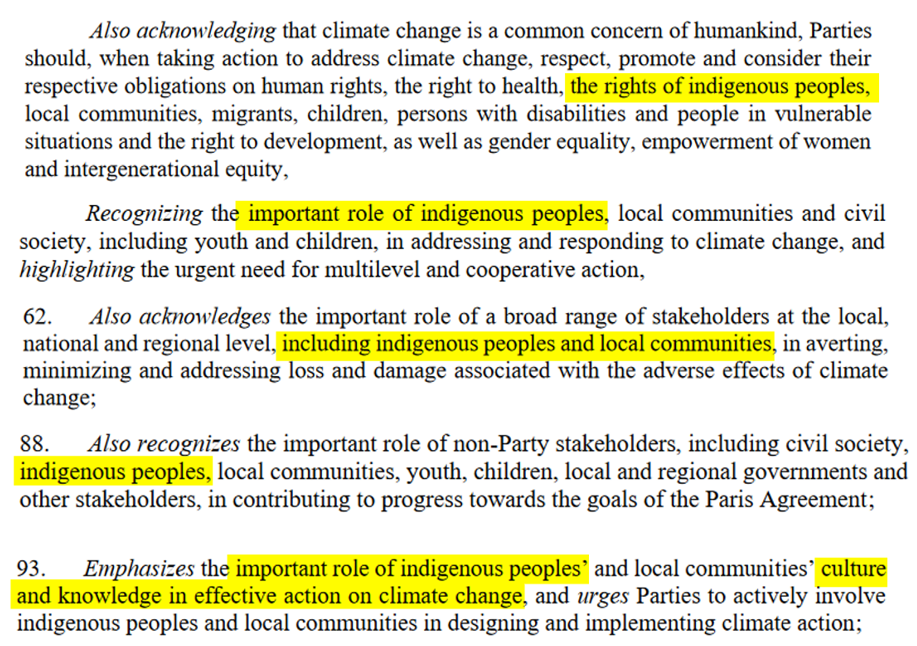
Articles mentioning ‘Indigenous peoples’

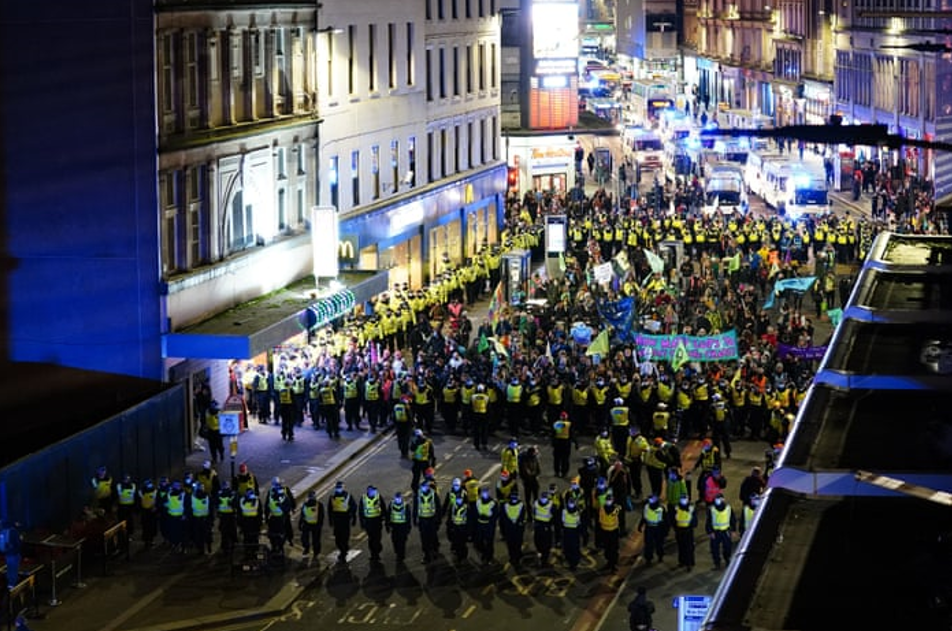
The COP26 summit addressed various issues, including the incorporation of indigenous people when consulting environmental issues. However, what is not mentioned is sometimes more important than what is. Nowhere do they mention who they mean by “indigenous peoples.” How they will consider the opinions of these people remains a mystery. Most absurdly, just outside of the gates of COP26 in Glasgow, a group of indigenous activists were protesting for representation. Ironically, COP26 was blocking out the exact people they promised to listen to.

Protest in Glasgow during COP26 (Guardian)

The dictionary definition of indigenous is to “originate naturally from a particular land.” Under this definition, no race is indigenous to America: we all have migrated from Africa at some point in history. However, only people present in America before Columbus are considered “indigenous.” (We wouldn’t call a white person born in New York an “indigenous New Yorker.”) This implies how “indigenous” is a term coined from a European viewpoint that swipes numerous tribal nations under the carpet.

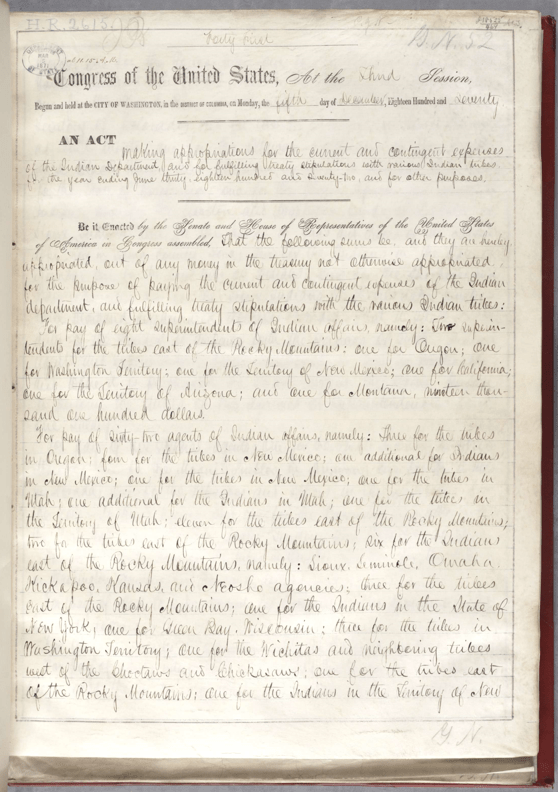
The biggest problem with this term is that, historically, “indigeneity” was used to oppress non-white people. In the nineteenth century, U.S. officials used the fact that these people maintained a lifestyle closer to nature to suggest that they were “backwards” and “primitive.” These racist assumptions were then used to appropriate their lands for U.S. benefit. Policies like the Indian Appropriations Act (1871) were justified on the basis that the “savages” of the tribal nations were not “civilised” enough to rationally use the land. The continuing tendency to view indigenous peoples as close to nature, yet not consider their voices with political weight implies a significant problem in resolving the climate crisis.

Indian Appropriations Act

We must think more politically when speaking of the environment. The history of environmentalism shows us that climate justice cannot be achieved by fighting within the conventional concepts made to separate nature from human life. As the conservationists of Leopold’s era were not thinking ethically enough about nature, the Glasgow Climate Pact shows us that we ourselves are not thinking politically enough about the human frameworks that underline the natural, scientific aspects of climate change. The failure of COP26 to represent grassroots protesters proves that we cannot rely on “experts” and heads-of-states to do this rethinking for us.

In this, history can be of useful service. History has the power to denaturalise. By looking at the history of how ideas like ‘ethics,’ ‘indigenous,’ or ‘environment’ were constructed, we can challenge traditional concepts that people often tend to assume as given. As the problem of climate change is always structural than individual, it is not enough to address environmental issues without tackling the political agendas that complicate its solution. We must continue to think beyond the categories we have grown accustomed to for so long. Time is of the essence.      

What is environmental history?

Is the ‘environment’ natural?

Before we begin, what even is the “environment”? We often think of the environment as synonymous with the natural world of animals, plants, and landscapes, where human civilisation hasn’t had its reach yet. A quick search on Google image reveals pictures of green, sublime images of the natural landscape. The dictionary definition of the environment is “the circumstances, objects, or conditions by which one is surrounded.” But such definitions seem a little absurd. Though we colloquially consider forests, mountains, rivers, and the biomes that inhabit it as part of the ‘natural environment,’ the border between what is natural and what is not becomes less clear-cut when we come closer to our own spheres of life. For instance, the pet dogs, domesticated cats, the eggs in the grocery store, roadside trees in the middle of the city… these are all, by right, part of ‘nature,’ yet we rarely think of them as part of the environment compared to their wild counterparts.

There is, however, one consistency in all these vague definitions of the environment:

  1. that our different depictions of the ‘environment’ are all devoid of humans, and
  2. that the closer natural organisms are to humans, they are considered ‘social’ rather that ‘environmental’ (for instance, leaves on a forest are considered to be part of the environment, whereas the parsley on my pasta for lunch today is not)
Google image search on ‘Environment’ – Where are all the humans?

Rather than having a stable definition in itself, we seem to think of the environment in terms of what it is not. In essence, we seem to think of the environment as anything not human.

            In today’s blog post, I wish to complicate this dichotomy a bit further. Studying the history of ideas (or ‘intellectual history’ as academics call it) tells us that there is a history to every abstract category. By looking at how categories such as gender, race, class, or ethnicity have been constructed by the ideas that people attribute to them, we can see how the categories we use colloquially today are not natural but artificial and human-made.

            But what about the ‘environment’? Some might consider it heretical to even question this categorisation. After all, the (natural) environment should be a pretty natural one, shouldn’t it? Even in the light of the current climate crisis and the wave of environmentalist movement following it, many would probably object to the act of trying to bring in any ‘human’ elements to the untouched, sublime environment. Still, since when did we start thinking of the environment as something separate from humans? Do we necessarily think about our surroundings the same way that people in medieval Europe did? Since when did we start distinguishing ourselves from our plant and animal counterparts to think of ourselves as part of a greater, super-human “society”? In other words, what is the history of the ‘environment’ as an idea?

Constructing the ‘Wilderness’ – The Case of North America

History reveals that there is nothing ‘natural’ about the environment. Our definition of the environment as something separate from human society is, as it turns out, an extremely Western one. Looking at the history of non-European lands, of non-White oppressed races and nations, we see that the environmental space was constructed with concretely political aims.

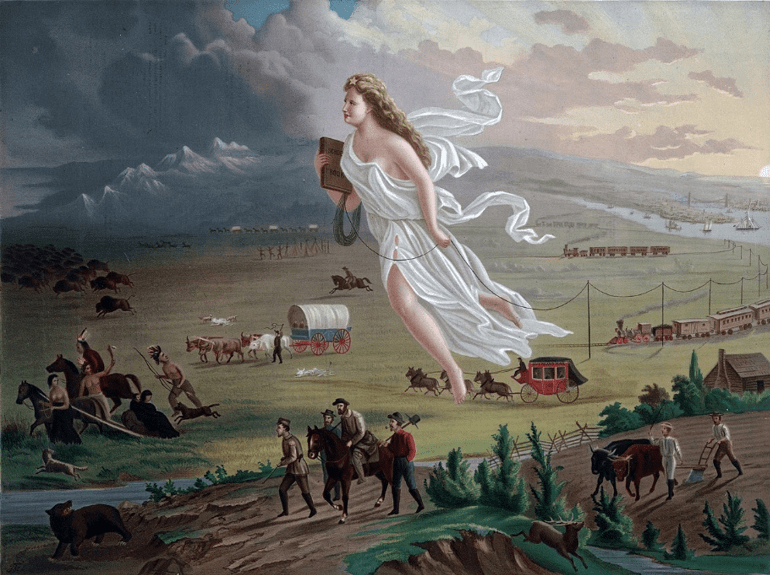
John Gast’s American Progress (1872) embodies the narrative of ‘Manifest Destiny’ as a destined expansion of U.S. civilisation upon the American wilderness.

The history of U.S. expansion in North America is a representative example of one such environmental space was constructed. From the 19th century onwards, the ‘wilderness’ beyond the U.S. Western border was seen as a sublime land untouched by human civilisation. As religious ideals of ‘God within nature’ grew stronger in transcendentalist movements of the 19th century, the North American wilderness became a glorified project for U.S. expansionist politicians. At the heart of this conceptualisation was the idea of an environmental space of the American ‘wilderness’ – a land thought to be untouched, untainted, and thus had yet to be developed by U.S. civilisation.

The problem of ‘wilderness’ is that the lands west of the U.S. were not untouched at all. In reality, the Western part of North America was densely populated by sophisticated societies of non-white tribes and rural farmers. Still, conquering an untouched ‘wilderness’ was easier than acquiring control over a land densely populated by diverse local peoples. As the wilderness was thought to be separate from human society, people in the U.S. did not oblige U.S. expansionist politics regarding the area as a matter of politics. Thus, depicting the western lands as an untouched wilderness enabled a depoliticization of a process that was, in fact, highly political and oppressive.

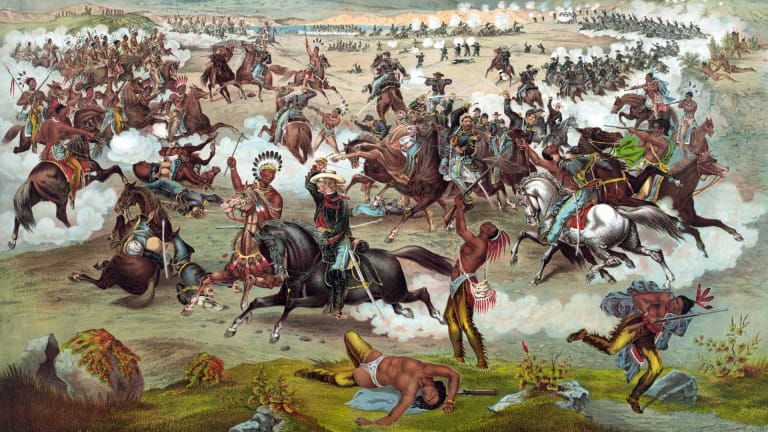
Brief footage of European “discoverers” conquering the American “environment.” (The Battle of Little Bighorn/credit: Buyenlarge/Getty Images)

Claiming an untouched ‘environment’ was easier than claiming a land densely populated by local non-white populations.

The history of ‘indigenous’ land appropriation shows how this ‘environment’ was not natural but in fact had very political repercussions (be mindful that the term ‘indigenous’ is an umbrella term that imposes a Western viewpoint that masks the variety of local tribal nations in the Americas). In 1871, the Indian Appropriations Act declared that ‘no Indian nation or tribe within the United States shall be acknowledged or recognized as an independent nation.’ The 1871 act mandated the forced relocation of these tribes to Indian reserves where they would be segregated and culturally ‘preserved’ from the influence of U.S. civilisation. In the solidification of U.S. nationhood, the existence of ‘savage’ tribal peoples in a ‘civilised’ nation like the U.S. was unacceptable. The frontier between the environmental ‘wilderness’ and society was actually one between diverse local non-whites and the U.S. empire.

Why we should think intersectionally when thinking about the environment

Therefore, environmental history is just about the ‘environment’ per se. The very definition of ‘environment’ (the surroundings in which an actor lives or operates) assumes that there is another subject that is central to its characterisation. Ignoring this component of environmental history by treating it as a discipline that only records facts about nature, biomes, and climates degrades the potential that history holds in an age such as ours. In essence, excluding humans from environmental history dehumanises and, consequently, depoliticises the discipline.

The current climate crisis is a distinctly human-made one and solving the crisis will require distinctly human approaches to the historical and political issues that complicate its solution. We cannot just wait for scientists to save the day. History has revealed that certain individuals or groups hold more responsibility than others in this crisis; ironically, those groups are also the ones that hold more power to bring about change for the better. Environmentalism and the struggle for environmental justice can only be sustainable when people of all races, ethnicities, genders, sexualities, classes, and nationalities have an equal voice in the solution. This is why we must think historically when thinking about the environment.

“Columbus Day” and the Dangers of Eurocentric Indigenous History

This eleventh of October marked the 29th anniversary of the Indigenous Peoples’ Day since the City Council of Berkeley renamed the day from its original form ‘Columbus Day’ in 1992. The day, established to restore agency to the people indigenous to the Americas marginalised in the colonialist rhetoric of ‘Columbus Day,’ received particular interest this year as U.S. president Joe Biden formally signed a presidential proclamation Indigenous Peoples’ Day to become a national holiday, becoming the first-ever president to recognise Indigenous Peoples’ Day. Though the need for the incorporation of indigenous peoples into the historical narrative should be a pretty straightforward one even without approval from a white president, the long-overdue recognition does imply a pressing need to contemplate the perceptions we have unquestioningly held about the past and their Eurocentricity. In the light of such events in October, in this month’s article, I will introduce a brief history of how discourses around the environment and environmentalism have put a white ‘Europe’ at its centre, marginalising the voices of BIPOC (Black, Indigenous, and People of Colour) communities.

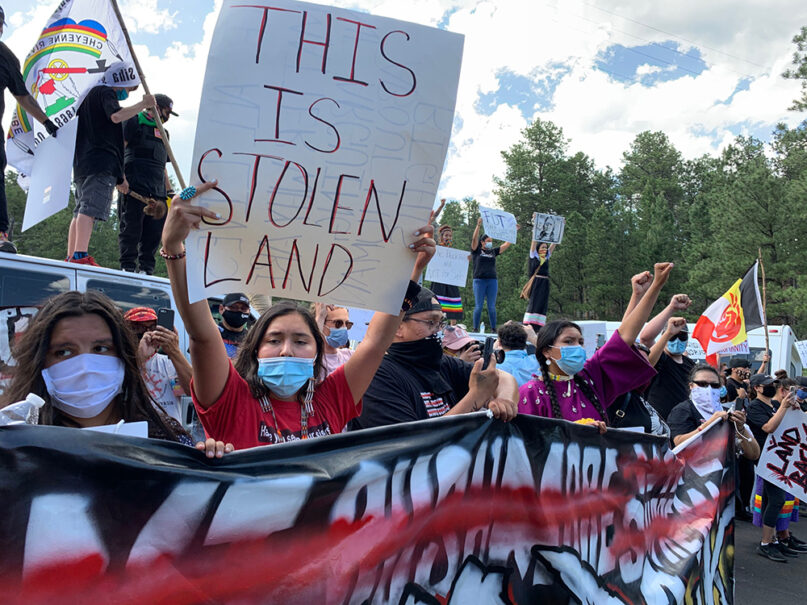
Native American protesters and supporters gather at the Black Hills, now the site of Mount Rushmore, on July 3, 2020 in Keystone, South Dakota. A multi-generational gathering, led by many young women and including different tribes, peacefully held the line.  (Photo by Micah Garen/Getty Images)
“This is Stolen Land” – Protesters and supporters gather at the Black Hills, now the site of Mount Rushmore, on July 3, 2020, in Keystone, South Dakota. (Photo by Micah Garen/Getty Images)

How non-white communities were more vulnerable to the effects of western environmental degradation

Environmentalism has existed before we found the language to express it from a European viewpoint. Though we often associate the incorporation of environmental factors in building our social spheres of life as a modern concept, the history of non-European environmental thought predates the invention of European ‘science’ modern environmentalism. Moreover, the dichotomous way of categorising nature as an external ‘environment’ as opposed to a ‘social’ sphere of human life is a European way of conceiving the structures around us. As those privileged enough to have their stories heard were often white activists, the ideas and accounts for environmental justice of BIPOC communities were often ignored and silenced.

This Eurocentric way of thinking about the environment is problematic as it precisely leaves out the very people who are most severely impacted by climate change and environmental degradation from the environmental discourse. As history unfolded into the 19th century and European empires went through mass industrialisation, the benefits of capitalist developments were exclusively reserved for WASP (White Anglo-Saxon Protestant) men, whereas non-white communities often had to deal with the consequences of industrialisation through the destruction of the environment. For instance, in the United States, cities were ‘colour-coded’ in order to regulate the kinds of housing you could purchase based on the colour of your skin. Even as the U.S. federal government created the Federal Housing Administration to provide loans so that the average person could own a home, ‘green’ coded homes that were of the highest value were all-white neighbourhoods, whereas districts that were coded ‘red’ were preserved exclusively for either integrated or all-black communities in the working-class. These red coded homes would be located where unregulated industrial production and waste emission affected life standards most severely (Melin Oliver, 2020).

Environmental degradation frequently threatened the lives of non-white workers in the agricultural sector as well. as Mexican workers deployed in the U.S. under the Bracero program were sprayed with DDT (Dichlorodiphenyltrichloroethane, a chemical compound used as insecticide famously introduced in Rachel Carson’s Silent Spring for its hazardous effects on the environment and human health) before they were sent to their contractors. Even today, dump fields and industrial sewages are located in places populated predominantly by Black and Brown communities who were chosen, in the words of a North Carolinian environmental protester Almena Myles, ‘because we were rural and poor and they thought we couldn’t fight’ (Bergman, BBC, 2019). Ironically, Black, Hispanic, Indigenous, and Asian migrant communities were being exploited to accelerate environmental destruction, from which they themselves would suffer the consequences. The glorious narrative of ‘progress’ and ‘rationality’ we often associate with capitalist development often erase and silence the histories of these people, upon whose labour and sacrifice of living conditions Western industrial development fundamentally relied.

Why we should think intersectionally when thinking about the environment

              The importance of thinking about intersectional histories of the environment and climate change comes from the fact that the obstacle to solving the climate crisis is a man-made one rather than a scientific one, in which certain individuals hold more responsibility than others. Merely directing the majority of the solutions to climate change to individualistic consumerism-based lifestyle reforms cannot address the bigger structural forces responsible for creating the climate crisis, while alienating people who are not affluent or privileged enough to maintain a consumerist “sustainable” lifestyle. Apocalyptic prognoses not based on sufficient scientific evidence that ‘we’re all doomed to die no matter what we do’ are bigoted and unhelpful, as such statements disregard the fact that climate change will first impact the peoples and societies least responsible for it. Environmentalism and the struggle for environmental justice can only be sustainable when people of all races, ethnicities, genders, sexualities, classes, and nationalities have an equal voice in the solution. Such inclusivity can only be achieved by considering the environmental history and the intersectional history of environmental thought, and this is where we as historians, not scientists, can contribute to the struggle for environmental justice.